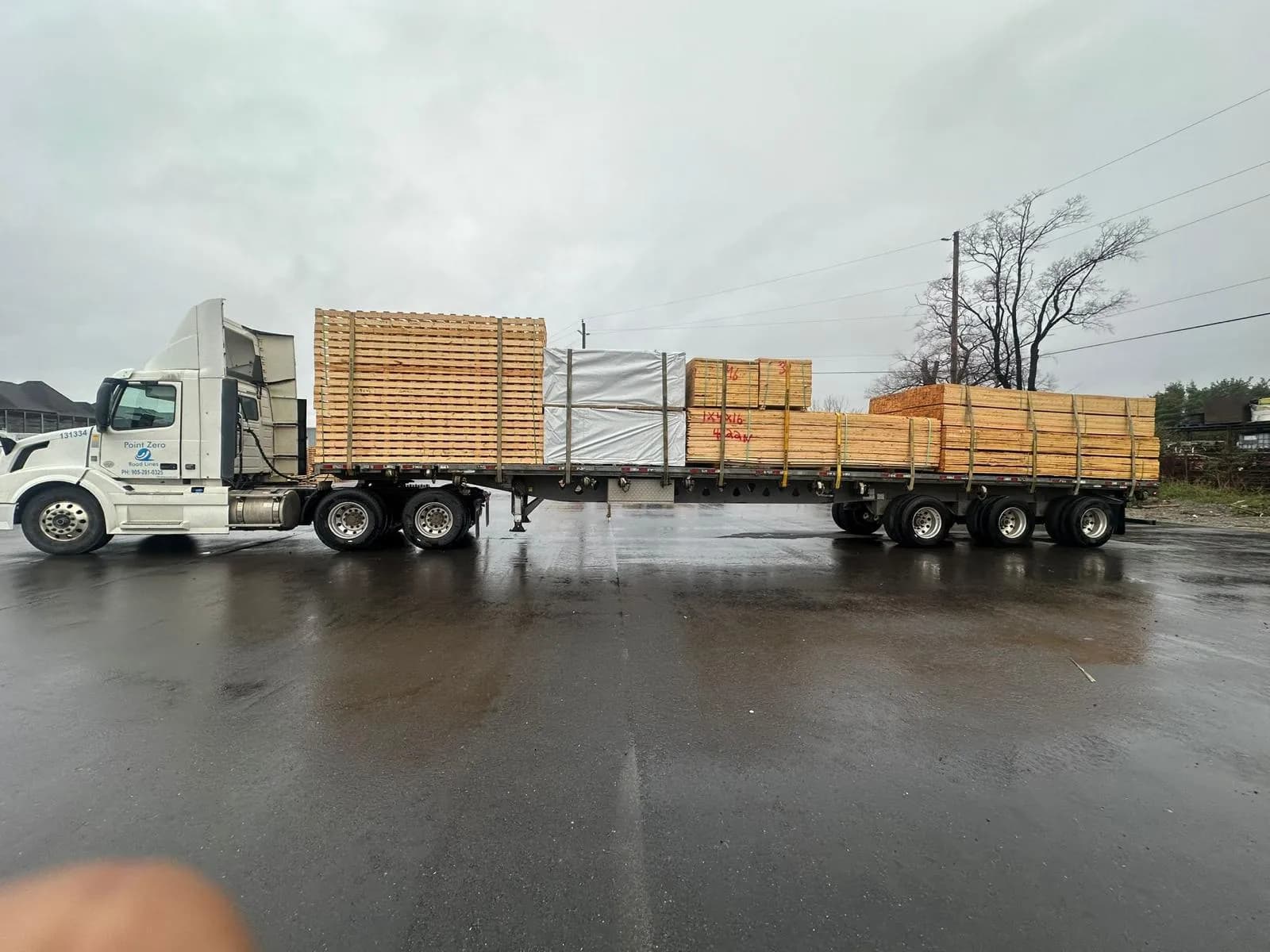
Flatbed freight is exposed, which makes securement the single most important part of the job. In Ontario, cargo securement follows the North American standard — National Safety Code (NSC) Standard 10 — adopted into provincial regulation. These are the fundamentals; they’re not a substitute for the regulation itself or professional judgment on a specific load.
The core principle: working load limit
Every tie-down, chain, strap, binder and anchor point has a Working Load Limit (WLL) — the maximum it’s rated to hold. The standard requires the aggregate WLL of all the devices holding a piece of cargo to be at least 50% of the weight of that cargo. The system also has to withstand defined forces: forward, rearward and sideways, plus lift.
Minimum number of tie-downs
The standard sets a minimum count based on the length and weight of the article being secured (in addition to meeting the WLL rule):
- Up to 1.52 m long and up to 500 kg: at least 1 tie-down.
- Up to 1.52 m long and over 500 kg: at least 2 tie-downs.
- Over 1.52 m: at least 2 tie-downs, plus 1 more for every additional 3.04 m (or part of it).
Articles that aren’t blocked against forward movement generally need tie-downs spaced so the freight can’t shift — commonly one near each end and additional ones along the length.
Edge protection, friction and inspection
- Edge protection: use corner protectors wherever a strap or chain passes over a sharp edge, so it can’t be cut or abraded.
- Friction / dunnage: blocking, bracing and friction mats help stop movement and let tie-downs do their job.
- Re-check en route: the driver must inspect the load within the first stretch of the trip and at intervals after, re-tensioning as loads settle.
Why it matters beyond the fine
A shifted or lost load is a safety hazard first and a compliance problem second. Proper securement protects other road users, keeps the freight intact, and keeps the carrier’s CVOR record clean. For construction materials, equipment and machinery — the loads that ride on flatbeds most — it’s the difference between a routine delivery and a roadside incident.
Frequently asked questions
What standard governs load securement in Ontario?
Ontario follows National Safety Code (NSC) Standard 10 — Cargo Securement, the harmonized North American standard, adopted into provincial regulation and enforced by the MTO.
What is the 50 percent rule?
The aggregate working load limit (WLL) of all the tie-downs securing a piece of cargo must be at least half the weight of that cargo. It’s a minimum — heavier or awkward loads often need more.
How often does a driver have to check the load?
The securement has to be inspected early in the trip and re-checked at regular intervals, with tie-downs re-tensioned as the load settles.
Have freight that fits this?
Talk to dispatch for a straight answer on equipment, timing and rates.